

Journal
Nature
Authors
Luke Grant, Inne Vanderkelen, Lukas Gudmundsson, Erich Fischer, Sonia I. Seneviratne and Wim Thiery
Date
07 May 2025
Global emergence of unprecedented lifetime exposure to climate extremes
Led by SPARCCLE partner VUB and co-authored by SPARCCLE researchers Wim Thiery (Vrije Universiteit Brussel), Lukas Gudmundsson (ETH Zurich) and Sonia I. Seneviratne (ETH Zurich), this global study published in Nature finds that children born in 2020 will face “unprecedented lifetime exposure” to extreme weather events, including heatwaves, droughts and wildfires.
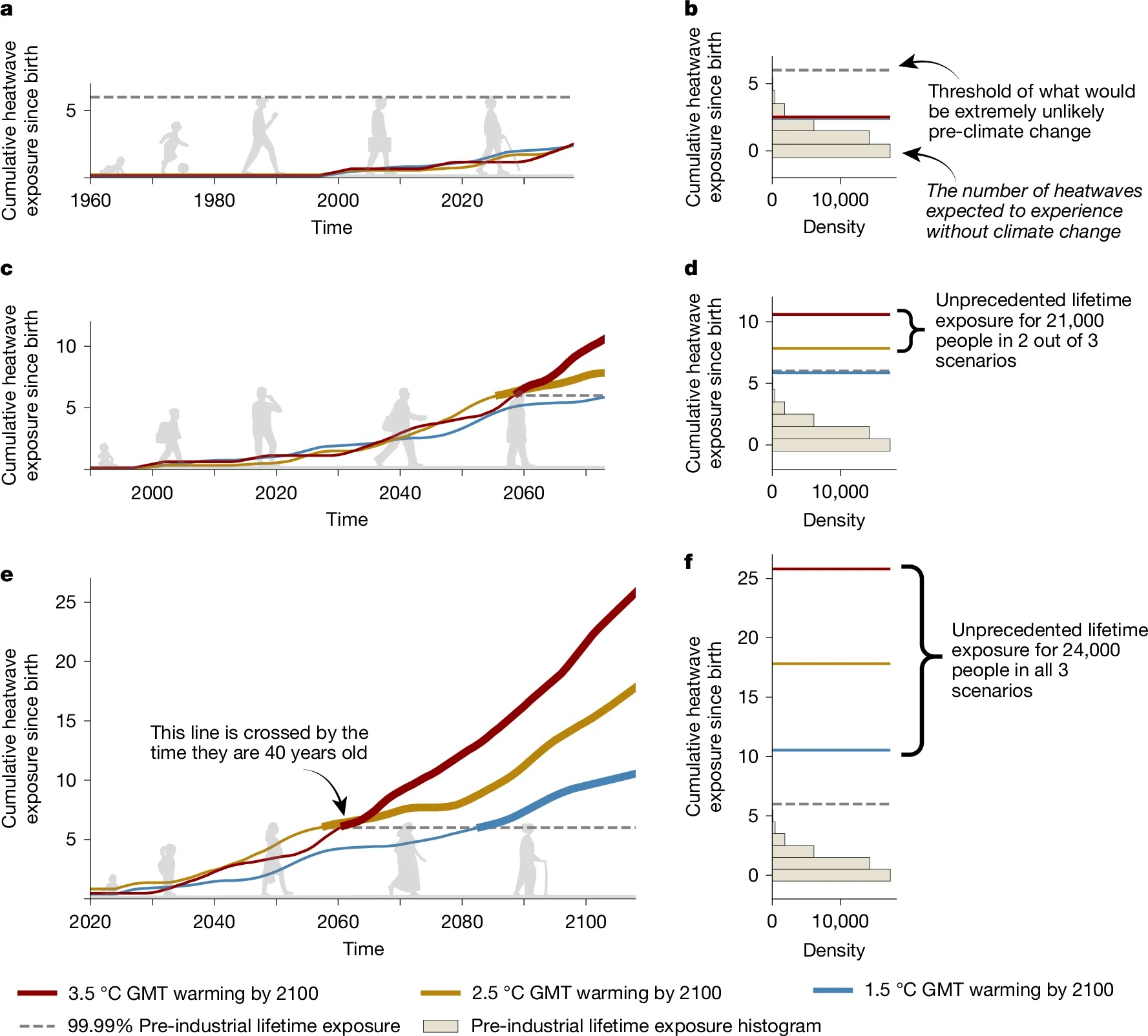
The study defines “unprecedented lifetime exposure” as a level of exposure so extreme that it would have had just one-in-10,000 chance of happening in a world without any greenhouse gas emissions.
The graphic below illustrates heat exposure since birth for people born in Brussels in 1960 (bottom row), 1990 (middle row) and 2020 (top row), across three future warming scenarios: 1.5 °C (blue), 2.5 °C (yellow) and 3.5 °C (red) by 2100. The dotted line marks the threshold for an “unprecedented” lifetime exposure to extreme heat.
The findings underscore the need for sustained greenhouse gas emissions reductions to lower the burden of climate change on young generations.
Extending this approach to the global scale reveals that millions of today’s young people will live through unprecedented lifetime exposure to heatwaves, crop failures, river floods, droughts, wildfires and tropical storms under current climate policies. If global temperatures rise by 3.5°C by 2100, 92% of children born in 2020 will experience unprecedented heatwave exposure over their lifetime, affecting 111 million children. Meeting the Paris Agreement’s 1.5°C target could protect 49 million children from this risk. This is only for one birth year; when instead taking into account all children who are between 5 and 18 years old today, this adds up to 1.5 billion children affected under a 3.5°C scenario, and to 654 million children that can be protected by remaining under the 1.5°C threshold.
The study also highlights that children with high socioeconomic vulnerability face an even greater likelihood of unprecedented exposure to climate extremes in their lifetime. Deep cuts in greenhouse gas emissions are urgently needed to safeguard the lives of children all around the world.
Related publication:
The Save the Children report “Born into the Climate Crisis 2: An unprecedented life – Protecting children’s rights” further discusses the findings presented in this article. The report is available here.
For more information:
Grant, L., Vanderkelen, I., Gudmundsson, L., Fischer, E., Seneviratne, S., & Thiery, W. (2025). Global emergence of unprecedented lifetime exposure to climate extremes. Nature, 641, 374–379. https://doi.org/10.1038/s41586-025-08907-1